
JANUARY 2026, WWPNA NEWSLETTER EXCERPT
Alameda Avenue Project:
What Changed—and Why the Community Has Been Shut Out
In our last issue, WWPNA reported that the Executive Director of the Department of Transportation and Infrastructure (DOTI) told the public the Alameda Lane Repurposing project was "moving forward." To our surprise, on November 7 we were notified through a press release that the City reversed course on the finalized "road diet" that was vetted with our community through DOTI's public process.
For more than five years, West Washington Park neighbors have been deeply engaged in a City-led effort to make Alameda Avenue safer. Alameda is one of Denver’s most crash-prone corridors, a High Injury Network (HIN) street where speed, volume, and design combine to create serious risks for people driving, walking, biking, and living nearby. You may have experienced the weekly crashes (51 a year on average) that cause severe backups, pushing frustrated drivers on to our smaller neighborhood streets.
After years of data collection, traffic analysis, public meetings, engineering design, and repeated community endorsement, Denver’s Department of Transportation and Infrastructure (DOTI) finalized a plan to repurpose two travel lanes on Alameda—referred to as the full lane repurposing, or "road diet."
A road diet is a traffic calming strategy that reconfigures a road, often by converting four lanes to three (two through-lanes and a center two-way left-turn lane)
That plan was endorsed by the DOTI Advisory Board and the Mayor's Pedestrian Advisory Committee; and supported by the West Washington Park Neighborhood Association (WWPNA). In April 2025 construction notices were distributed notifying residents of construction beginning that summer.
Then, abruptly, and without communicating with WWPNA, the City changed course. On November 7, DOTI announced a revised design—the partial lane repurposing—which retains 4 lanes of traffic, two lanes of traffic in the eastbound direction and makes one of the westbound lanes a turn lane. The new plan removed a 5 foot pedestrian buffer that would have protected neighbors walking to businesses and students heading to Steele Elementary from speeding traffic. Even more troubling than the downgrade itself is the City’s refusal to allow the neighborhood to compare the two plans side by side. Instead, residents are being told they may only comment on the details of the weaker, less safe alternative.
In effect, five years of community feedback supporting the full lane repurposing has been erased.
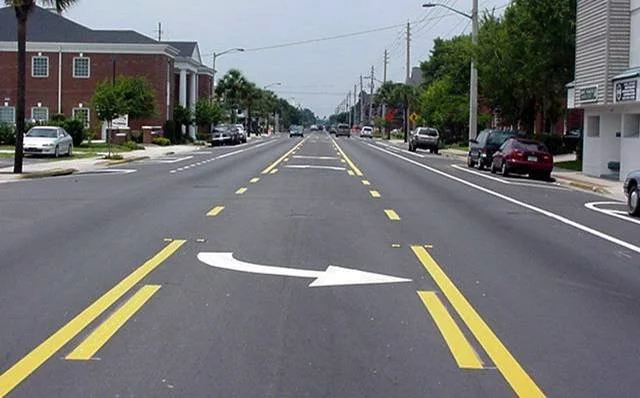
Example of a "Full Lane Repurposing" (also called a 4 to 3-lane conversion) Image: Federal Highway Administration
Sign the WWPNA Petition for a safer Alameda
Five years of public process, erased
From 2019 through 2024, DOTI followed its own established planning process for Alameda Avenue.
This process included virtual and in-person meetings (at Lincoln Elementary and Steele Elementary), traffic modeling, crash analysis, and a final engineering design completed in October 2024. DOTI staff repeatedly presented the full lane repurposing as the preferred and recommended option. In the Spring, when DOTI employees met directly with business owners along the corridor, they reported hearing no opposition to the full lane reduction design.
By April 2025, neighbors were formally notified with a hand-delivered construction notice that construction would begin that summer and be complete in 2025.
Much of this documentation has since been removed from DOTI’s website, but it remains preserved through public records and DOTI Advisory Board testimony, available through Colorado Open Records (CORA) requests and web archives.
A sudden pivot—driven by politics, not data
The shift away from the full lane repurposing did not originate from new traffic data or safety concerns. It began after pressure from a small number of politically connected stakeholders.
On June 5, 2025, Jill Anschutz emailed DOTI Director Amy Ford expressing concern that her left turns on to Alameda could be impacted, and that the project might cause cut-through traffic. Days later, DOTI convened a “Concerned Stakeholders” meeting with Anschutz and lobbyist Jason Gallardo. At that meeting, DOTI staff reiterated that "the full lane repurposing was the way to go."
On July 16, a DOTI program manager followed up in writing, stating that DOTI’s analysis showed “impact on side streets will be minimal,” and provided detailed traffic and crash data to support that conclusion.
Despite this, on July 31, Anschutz sent a letter to the Mayor on behalf of a group called Act for Alameda requesting the project be paused, accompanied by a petition with roughly 300 signatures.
Behind the scenes, the tone inside DOTI shifted. An August 14 email from DOTI engineering supervisor Brett Boncore to the project team stated:
DOTI decided to keep four lanes of traffic on Alameda, rather than implement the "road diet" that had been vetted with our community. This decision came after final design, and after construction had been announced.
Contradictory messaging from DOTI
One of the most concerning aspects of this reversal is the City’s contradictory and evolving justification.
1. Cut-through traffic:
Earlier this year, DOTI described the risk of cut-through traffic from a full lane repurposing as “minimal.” And yet, that same claim is now being used as a central rationale for downgrading safety on Alameda.
2. Speed reduction:
DOTI previously stated that slowing drivers was a core project goal, acknowledging the well-established safety principle that higher speeds dramatically increase the likelihood of severe or fatal crashes. The partial lane repurposing, which preserves higher-speed, multi-lane conditions in one direction, directly undermines that goal.
3. Project delay explanation:
In September, DOTI told its advisory board the project was delayed due to the Alameda underpass construction. There was no mention that the schedule had been extended by years (now scheduled to be complete at the end of 2027) because the City chose to redesign the project. This misrepresentation was repeated during a contentious November 18 Advisory Board meeting, where Director Ford denied that lobbying or political pressure played a role. "This had nothing to do with a lobbyist." Ford said.
Safety Analysis— deliberately removed
Perhaps most alarming is how DOTI handled a safety analysis for the new partial design.
When the City directed its contractor, Kimley-Horn, to revise the project in August, the updated scope initially included 2–3 months of traffic and safety analysis. DOTI eliminated nearly all safety and traffic analysis.
Specifically, DOTI cut: all new data collection, traffic counts, diversion (cut-thru) analysis, side-street impact analysis, independent safety validation, documentation of findings.
A November 6 revised contract explicitly removed safety analysis from the scope of work, limiting evaluation to corridor driver delay only.
Despite this, Director Ford publicly claimed that the partial lane repurposing is “just as safe” as the original design. According to CU Denver professor of Civil Engineering and transportation expert, Wes Marshall, quoted in a 9NEWS investigation, the City’s work amounts to “back-of-the-envelope” estimates—not a real safety study.
Partial repurposing is more expensive—and less efficient
Documents released through a CORA request show that the costs of this project ballooned. DOTI will spend an extra $100k or more redesigning Alameda's already finalized design.
As highlighted on 9NEWS, the partial lane repurposing preserves higher speeds, longer crossing distances, and complex lane configurations that are known to increase crash severity. By contrast, full lane repurposing reduces conflict points, improves predictability, and smooths traffic flow.
Contrary to popular fear, full lane repurposing does not typically create congestion. On streets like Alameda—where signals, turning movements, and crashes already increase the time it takes drivers to move through the area—lane reductions often improve efficiency by reducing erratic driving and crash-related delays. Fewer crashes mean fewer backups, fewer neighborhood cut-throughs, and more reliable travel times for everyone.
DOTI’s own earlier analysis supported these conclusions.
December WWPNA meeting: a community united
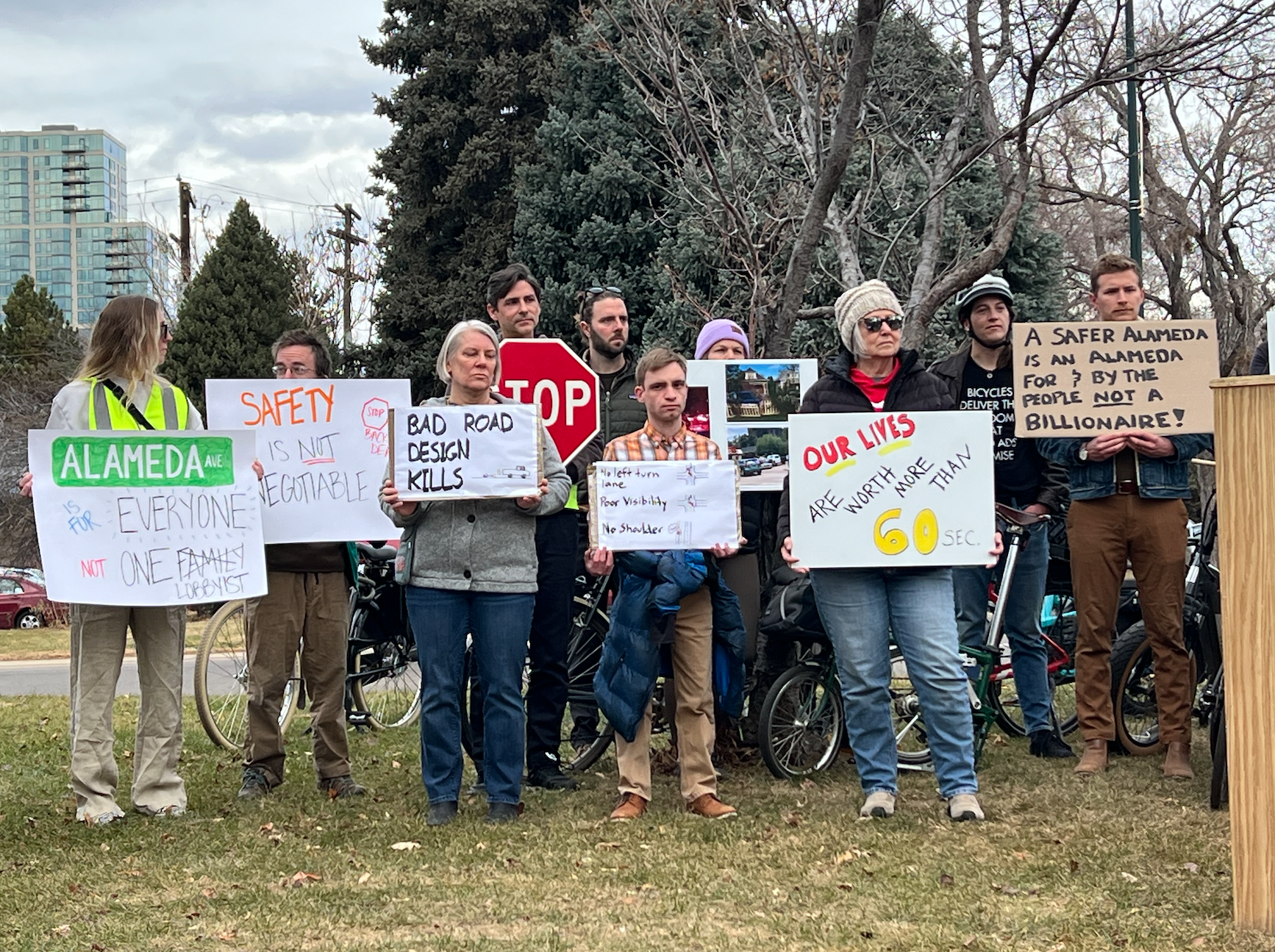
At the December WWPNA meeting, covered by 9News, Denver7 and Denverite, residents expressed frustration not just with the downgraded design, but with the process itself.
Neighbors questioned why a fully vetted safety project was altered after the project was finalized, why the City refused to reconsider the original design, and why community input now appears limited to cosmetic feedback on a plan no one asked for.
Since November 19, more than 1,100 people have signed a WWPNA petition (70% of signers are from West and East Wash Park) calling for restoration of the full lane repurposing—more than three times the number cited in the letter that helped derail it.
What the neighborhood is asking
On December 11, WWPNA held a press conference to reveal what we have learned about the process that happened behind closed doors between June and November. WWPNA also sent a letter to Mayor Johnston and Director Ford on December 11th along with 1,030 signatures. That letter asked that our petition receive the same consideration that the Act for Alameda letter received.
WWPNA is asking for the City to honor the work already done.
In a response to the WWPNA Petition, the Mayor's Office released a statement on December 19th reiterating the reasons they chose to change the plan for Alameda, including decreasing travel time on Alameda for drivers by about 60 seconds, and reducing cut-through traffic by one vehicle every 4 minutes. Their response notes that they are "still examining how to include an added buffer in the partial lane repurposing." It is not clear how a buffer will be added into a 40-foot wide road with four 10 foot lanes.
In the response, DOTI said they will continue to collect community feedback. As this newsletter goes to press, neighbors wonder: Will DOTI ever allow the community to weigh in on both options—full and partial lane repurposing?
Alameda Avenue deserves a solution driven by data, safety, and the people who live here—not by political pressure applied after the project had been fully designed, approved, and scheduled for construction.